

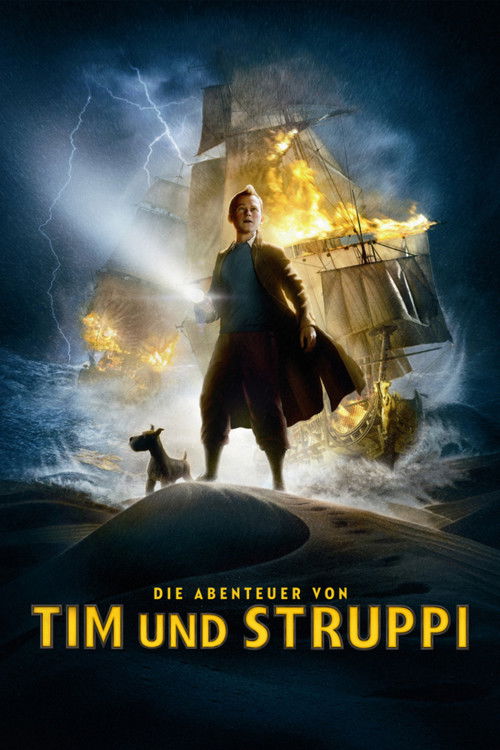
 Tintin is having his portrait done in the square, drawn just as he appears in the comic. At a market, on his way home with Snowy, he spots a model ship for sale. It’s the Unicorn, and just after he buys it, two men offer him a large sum for it: Tintin refuses. With the ship at home, his curiosity about its story is stirred. But strangers break into his flat and steal it. What secret does the Unicorn hide? That’s how Tintin, with Snowy at his side, sets off on an adventure to uncover it that will take them around the world…
What have we got?
- A film directed by Steven Spielberg, shot digitally, rendered in 3D and animated by Peter Jackson’s studio.
- A story based on the adventures of Tintin and a tribute to the work (the artist who draws Tintin’s portrait in the opening scene is modelled on Hergé himself).
- A director and a producer who are fans of the character.
- A long-running project that began in 1983 when Spielberg acquired the rights to Tintin.
- The first film in the trilogy of an ambitious project: re-creating the world Hergé imagined.
What haven’t we got?
- A literal reproduction of The Secret of the Unicorn.
- Unjustified 3D.
- Political references or social criticism.
How does it turn out?
A carefully crafted animated film, made with real care, with 3D that adds depth, realism to the settings and action scenes. The landscapes are spectacular. The script conveys the mystery and arouses the curiosity we found in the comic. The characters respect the essence of the original: Tintin is curious, intelligent, brave, fair and adventurous; Snowy is the dog who is always at his side and helps in any way he can; Thomson and Thompson keep the stupidity and sense of duty that define them; and Captain Haddock… well, he’s Captain Haddock! Even physically the characterisations are very well judged (despite Tintin’s sexless face). The script is based on The Crab with the Golden Claws, The Secret of the Unicorn and Red Rackham’s Treasure, which may confuse the more critical about the story’s fidelity, since the title points to only one of the three.
For those of you not familiar with Tintin, here you’ll find mystery and adventure, mixed with moments of great action. As early as 1981, Tintin was being compared with Raiders of the Lost Ark (that’s when the director first took an interest), and there are similarities, so if you like that kind of film it may appeal to you. It’s aimed at a young audience (like the comic), although the plot is interesting enough for adults too (especially the nostalgic ones). Despite being animated, I wouldn’t recommend it for the very little ones.
The film is entertaining and, as an introduction to Tintin’s world, a marvel. It seems Hergé was right when he said that ‘Spielberg is the only one who could do Tintin justice’. We’ll see what Peter Jackson, the director of the second one, does with it: the foundations have been laid.
Highly recommended, nostalgia renewed.