

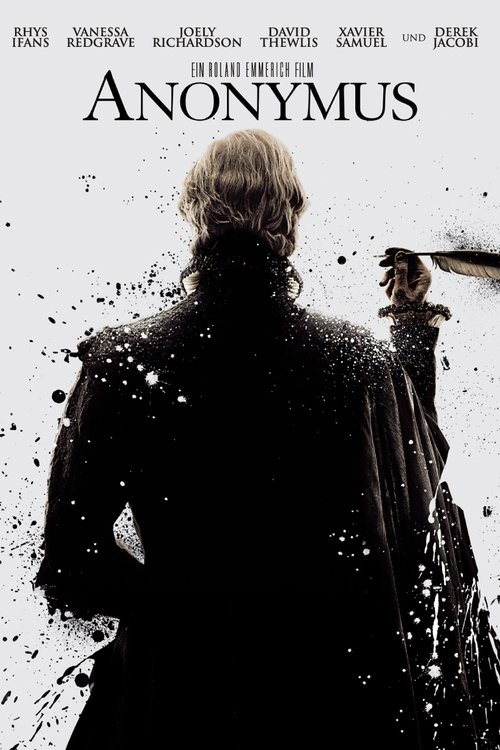
 Oxfordianism is a theory that suggests Edward de Vere, Earl of Oxford, as the true author of the works attributed to Shakespeare. Experts normally vouch for authorship on the strength of historical evidence: archives, contemporary testimony, historians. The Oxfordians build their case on the assumption that the plays are autobiographical, using them to draw up a profile of the author that differs from the Shakespeare we know and points towards the Earl of Oxford. They discredit the historical records, arguing that these were tampered with to protect the identity of the real author, above all because of the political climate of the time. The film is a re-creation of that period and of the circumstances that led to the plays being credited to Shakespeare, based on the Oxfordian theory.
What have we got?
- Roland Emmerich (Godzilla, Independence Day), director of big productions, special effects and astronomical budgets.
- A story that starts from a controversy but develops around the succession to Elizabeth I’s throne.
- Efficient actors: Rhys Ifans (you may know him from Notting Hill or the magnificent The Boat That Rocked) and Vanessa Redgrave (Howards End).
- Cinematography that’s pleasant to look at.
- Unnecessary special effects.
What haven’t we got?
- Historical accuracy in the details.
- Credibility from the director (sensationalism in The Day After Tomorrow, historical research in the deadly dull 10,000 BC).
How does it turn out?
A product that tries to shine in many ways and ends up mediocre in nearly all of them, with a few notable moments. Let’s be clear that it isn’t a documentary, even though it starts out like one. The events it presents are an independent reinterpretation of history, put together to justify the confusion over who wrote Shakespeare’s works. What’s the problem? Well, it isn’t clear who the right audience is. I can see two kinds: the Oxfordians and everyone else. If you’re an Oxfordian you’ll almost certainly like it. If you aren’t, but you know the history, it will probably irritate you. There are some inaccuracies, and the script has to be given a great deal of credit. It doesn’t illustrate and it doesn’t convince. Take away the layer of historical background (which most of the audience will have) and you’re left with a film of little substance and dwindling interest. It’s hard to follow because it takes so much information for granted.
That said, the performances are solid, especially Rhys Ifans as the Earl. The sets are impeccable (the reconstruction of the original Globe is spectacular), and even the re-creation of what the plays of the time must have looked like on stage. Those moments on screen are sublime. The plot behind the story is intriguing but can’t be fully appreciated: there are too many historical assumptions. We get an exalted Earl and a Shakespeare drawn to the point of ridicule, perhaps an exaggeration. More historical rigour would have made it more credible; it’s hard to tell what’s true and what isn’t. In the end it’s strictly entertainment, and it distorts the spirit of the original question: was Shakespeare a fraud? I don’t know, but the film certainly is.
Watch it if you’re a Shakespeare fan, if the Oxford theory interests you, if you like a bit of sensationalism, or if you didn’t fall asleep during 10,000 BC. With some historical research beforehand it may be interesting, and it has a few brilliant moments. For historical fiction, the masterful Amadeus is far better.
Swallowable.